Leaside

May 22: OK Kiddies, pay attention. Today we have a history lesson and it will be on the exam.
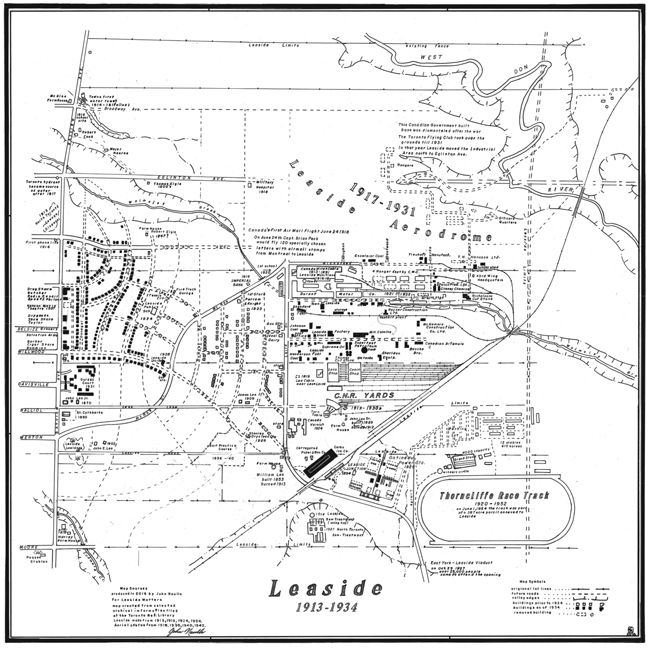
LeasideMap_J_Naulls_web
Leaside 1913 – 1934

Leaside is a relatively unique neighbourhood in the City.  The land for its’ development (1,025 acres) was assembled by the Canadian Northern Railway in 1912. The railway retained Frederick Gage Todd, a student of  Frederick Law Olmstead (who designed Central Park in New York, among other places), who then drafted a plan for residential neighbourhoods, commercial districts and industrial areas, all in support of a new railway yard and station in Leaside.

The plan was influenced by the design principles of the “Garden City” movement that emerged in Britain at the turn of the last century. The Garden City movement was promoted by Ebenezer Howard and others as a utopian model for the development of new towns.

British cities of that time were dangerous and horrible places to live. Living conditions were abysmal; there were virtually no social services; disease was rampant, the air and ground were polluted. Like all megalomaniac City Planners, the Garden City proponents believed that a well-designed living environment would lead to a healthier and happier populace. Their prototypical cities were designed with separate residential neighbourhoods mixing a range of housing forms. Broad curvilinear boulevards ran through the neighbourhoods and connected to the industrial areas. Homes and jobs were in balance and there were designated areas for shopping and city purposes. All of this was placed at a distance from the main city, and surrounded by permanent open space – hence “garden city”. This approach is foundational to much of the city planning thought of the 50’s and 60’s which sought to separate uses and create an “ideal” place to live. Don Mills is a classic example of that era.

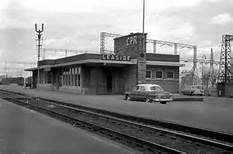
Development of Leaside didn’t start until the 1920’s, and not all of the plan was realized. The key neighbourhoods and the industrial areas were put in place. As planned, Leaside was home to a major rail terminal and maintenance operation. The former locomotive shop has now been convertLeaside stationed to a grocery store, and sadly, the station itself is long-gone but the railway remains a presence in the community. Other early industries included the Durant Motor Company, Canada Wire and Cable, and Sangamo Meters (who had a steam locomotive beside their factory as an emergency generator). Leaside was also a key provider of ammunition during the first World War, and is believed to be the landing point for the first air mail shipment in Canada.
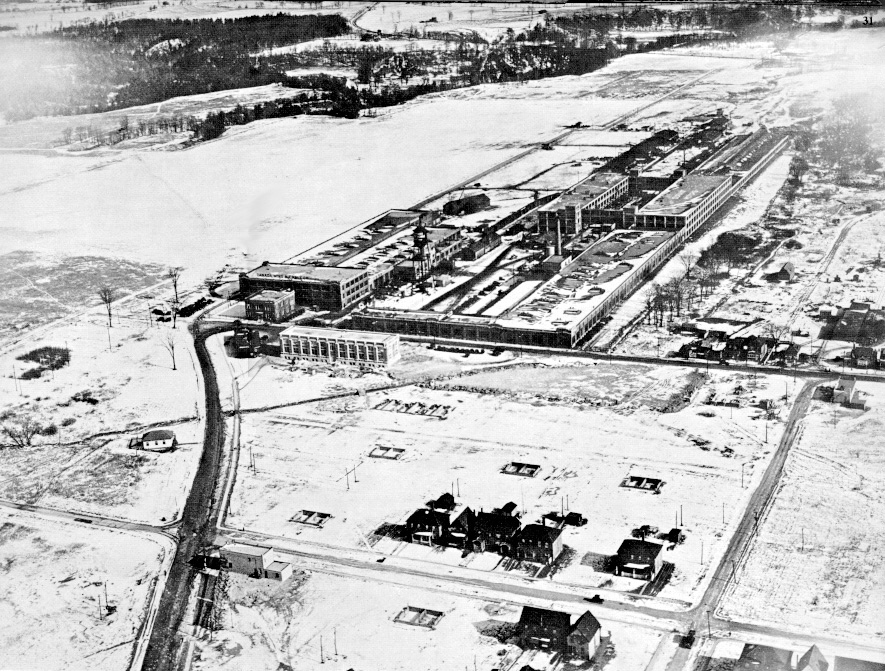
Leaside aerial
Laird at McRae 1928

Almost all of the houses in Leaside were erected between 1928 and 1953. My home – the Garden Court apartments – were built in 1930. Three farmhouses that belonged to the original settlers (John Lea Jr., James Lea, and Thomas Elgie) remain in place. Several blocks of houses were built by the industries so that their employees could live close to the factory. Virtually the entire neighbourhood, including several apartment blocks, is two or three stories in height and presents a very modest and consistent appearance.

Many in the neighbourhood are correctly concerned about major redevelopment proposals along Eglinton Avenue, and a growing number of the older and small homes are being demolished to make way for “monster homes” that really don’t fit the character of the neighbourhood. So Leaside continues to evolve. We can only wonder what it will be like in the next 50 years.

Map by J. Naulls. For more information see: http://leasidematters.ca/

Leaside 2

May 22: The Garden Court apartments where I live, complete the City Planner’s wet-dream that is Leaside. The apartments were designed by Forsey Page and Harland Steele, the founding partners of Page and Steele Architects. Both Page and Steele died during the 70’s, but the firm continues to practice today. During the 1950’s, the firm employed Peter Dickinson who was responsible for designing many well-known Toronto landmarks including the O’Keefe (now Hummingbird) Centre, and the Benvenuto Apartments. The firm’s current portfolio contains many, more ambitious high-rise projects including the 60-storey 33 Bay Street and the 50-storey West One in the Railway Lands. Times have certainly changed.

IMG_2188[1]Sharp eyes will have noticed that the Garden Court was an anomalous block on the plan for Leaside. It was a large, square parcel that did not integrate with the road pattern or land use plans laid out in 1913 by Frederick Gage Todd. Where other planned apartment sites along Bayview Avenue and Mallory Crescent extend about a half-block back from the street, Garden Court is substantially larger (at about 6 acres) and clearly a different animal. I have not uncovered the reason for this situation; perhaps it was a separate lot that was not part of the larger Lea / Elgie assembly.

IMG_2181[1]Whatever the reason, the apartments were mostly constructed in 1930 – 31. They are all walk-up 2 and 3 storey buildings (some 4 storeys if you count the few basement apartments). The site plan continues the thinking of the Garden City movement. There is a mix of apartments and townhouses fronting the streets. There is a broad walkway perpendicular to Bayview Avenue connecting through the site to Berney Crescent. In the centre of the site is a courtyard enclosed by the buildings and formal landscaping and tree planting. Residents have direct access to “nature” and some of the ground floor units – like mine – have access to the courtyards from both the front and the back.

What this all means is that we seem to have a nice mix of newcomers and long-term residents. There’s a mix of ages, and possibly incomes, although the units are being renovated as they become vacant so the rent level is obviously rising. The courtyard system means that I frequently run into other residents, and we share news and common interests like gardening in the planters (one woman has done all the planting in our courtyard). The fact that we sit right on Bayview makes this the most convenient place I have ever lived – truly that “urban experience” I was looking for when I left the house. I feel fortunate to be here.

http://gardencourtapartments.info/

Little Greenies

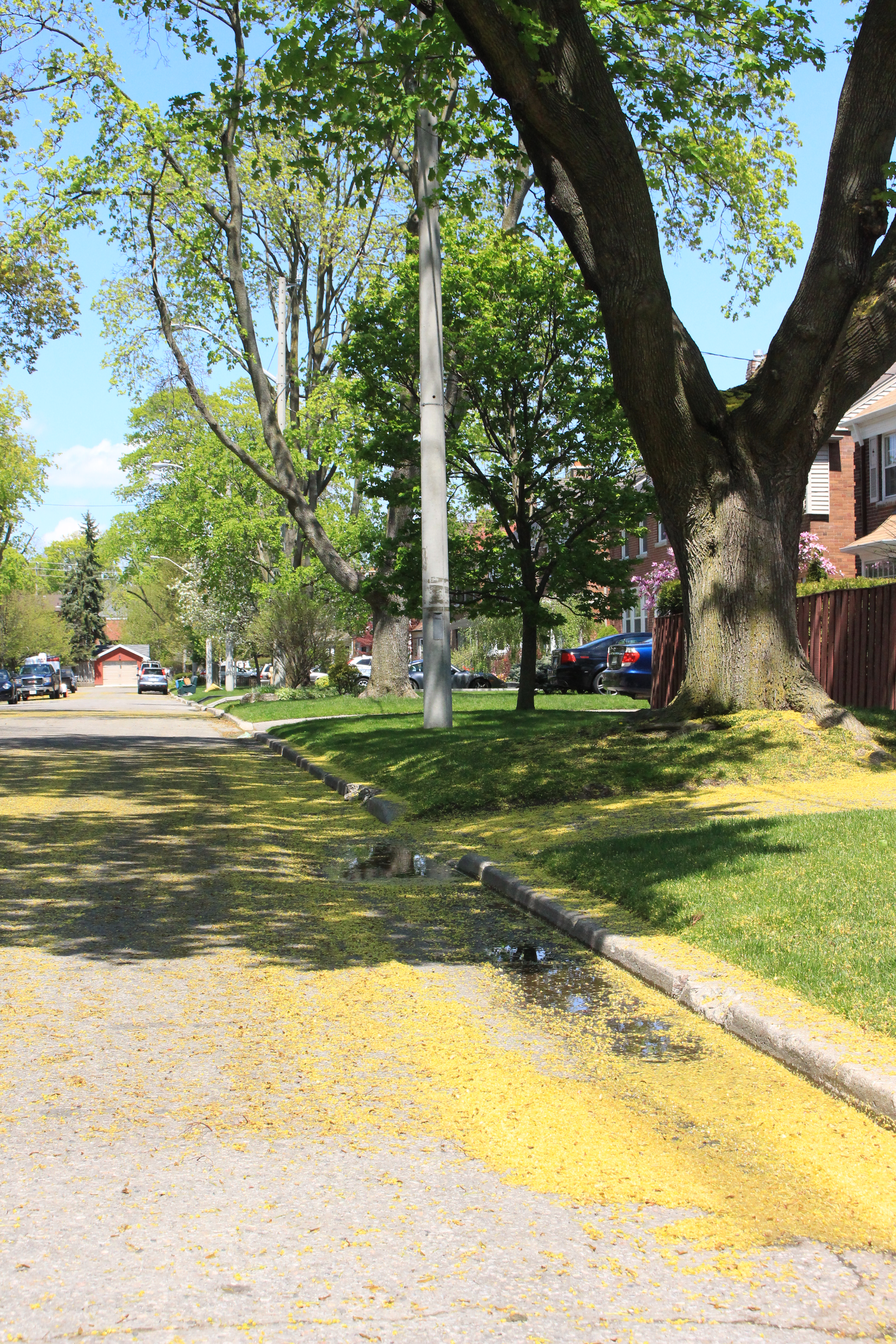
IMG_2167May 14: Today there are zillions of lime-green Maple florets in the street. In some places they are like a fuzzy green carpet. Soon they will be replaced with zillions of Maple keys as Spring continues to expand into Summer. But right now, I’m reminded of a day decades ago when those little greenies lay thick on the ground.

I was 17. It was the day when I took delivery of my very first motorcycle – my very first vehicle of any kind. I think it cost about $600 and I had worked part time for several years gathering the money to buy it.

It was a bit of a surprise that my parents had agreed to let me have a motorcycle, even though I’m sure that safety was a huge concern for them. People – particularly young people – had discovered small and cute motorcycles (“You meet the nicest people on a Honda” was an advertising campaign of the day.) and they were riding them with very little experience. Drivers did not encounter many “real” motorcycles at that time, and they were not particularly careful around these small newcomers. Safety standards, and helmet laws, were lax or nonexistent so many, many people were getting hurt or killed.

I visited the Yamaha dealer on a routine basis throughout the Winter to make sure that the bike was still there. And finally, as Spring approached, my Dad and I went down to the shop on Birch Avenue and bought it. Although it’s hard to believe now, I think that my 100 cc Twin Jet was the largest displacement bike among my group of friends, although I know I was soon pushed off the throne by other much larger bikes – 150 and 180 cc monsters.

Finally, on a day after school, I went down to 100the shop and picked up the bike. The first ride was back to Inglewood Drive where everyone was hanging around. I was so proud and happy as I rode up the street to join them on the corner, under the Maple tree, surrounded by a  carpet of green. I remember it as a very happy time. I had a privileged life: I had no real responsibilities beyond cutting the grass at home, and enough money for gas. Although I worked part time over the Summer, I had enough time off to head to the cottage for a couple of weeks, I had a woman who could be called my girlfriend with a straight face, and many friends in the neighbourhood.

We were on the cusp of transitioning from children to adults, and with apologies for overworking the metaphor, the transition of the Maple trees into bloom reminds me very much of those happy and carefree days.

Gratitude

May 8: Spring is a time of rebirth, of hopefulness and potential. I find it a very positive time, full of the possibility of better things to come. Recently though, I’ve been considering some of the things I already have. The first draft of this blog read like a Hollywood “thank-you-for-the-award” speech, for there are many specific people who have had a significant and positive impact on my well-being. Rather than list them all, and risk missing someone important, I’ve decided on a brief list of things for which I am grateful.

Health: Although I have been hobbled for the last month or so with a sprained ankle, my overall physical and mental health is quite good. I believe I am in a good place emotionally and spiritually, and I have a positive outlook. I’m active and engaged physically and mentally.

Friends: At retirement, many people lose most of their friends. I have consciously tried to retain as many friends from the City as I can. We spent many years together so we have common memories. There’s no need for that relationship to end simply because we are not at work any more.

I am in Alanon because of my Father’s drinking. I have many friends in the program, and a few closer friends I see outside meetings to share support and insight. They keep me focussed on what’s important and right for me.

I’ve also made good friends with a few people in the neighbourhoods where I have lived. Since I moved, this has taken a bit of extra effort, but I still appreciate staying in touch. And there are my really close friends – “the gang” as my Mother used to call them before gangs became a cultural problem. These are the guys I have known forever – some since public school – and who know where the skeletons are buried. We don’t connect often but when we do we share a real affection and concern for each others’ well-being that I value deeply.

Family: My Mother is in her 94th year, and although her memory has begun to slip, she’s still in pretty good shape physically. She’s the one that tried to shelter us from Dad’s drinking, and provide a consistent and loving foundation during our early years. We are lucky to still have her in our lives.

My sister Nancy is a rock. She’s an anchor for me and I am glad that we remain close. She has been there for me at times when others were not available, and her support and love is something I cherish. Her family is a source of inspiration and joy. It’s pretty nice to be the old, weird uncle that gets invited to dinner on special occasions.

My cousin James has been my “brother by a different Mother”. We’ve known each other literally since birth. We are not alike, yet we have shared so much positive energy and growth in our lives, it’s hard to imagine where I would be today without him in my life.

And Marisa, my lovely and wonderful daughter. I realize now that I was not the most attentive Father when she was younger. But we are close today, and it feels like our relationship grows closer each time we get together. I treasure the times we spend together as adults – not Father and Daughter –  sharing lunch and a laugh. Of course, two adorable grand-daughters are a good reason to get together…..

I realize that none of this is earth-shaking. We all have things in our lives that are positive, but sometimes it’s easy to lose sight of them. Maybe with Spring cleaning you can dust off a few of your own.