Ending It All

June 27: The time has come to consider ending it all. I don’t mean this in the throw-a-rope-over-a-beam way, but I feel that I do need to consider abandoning motorcycling.

I rode for 2 years starting when I was 16. I then sold that bike to pay for school tuition andDavid1967Bike didn’t ride again until I was 28, so I’ve ridden for 40 years and have the scars to prove it. I’ve ridden everything from a Yamaha 100 Twin Jet up to a Yamaha FJ1100 upon which I rode the Peterson Road north of Wilberforce at a steady 140 km/h. My current bike is a Honda VFR 800 with 104,000 kilometers on it. I’ve ridden it to Maine at least 4 times; to the Cabot Trail once; to New York, Pennsylvania and Ohio more times than I can count. I’ve ridden in Europe three times including last year. My trip there with Melinda on a BMW 750 K to celebrate my 50th birthday still ranks as one of the best holidays I’ve had. All of this is to say that I don’t feel I have anything left to prove.
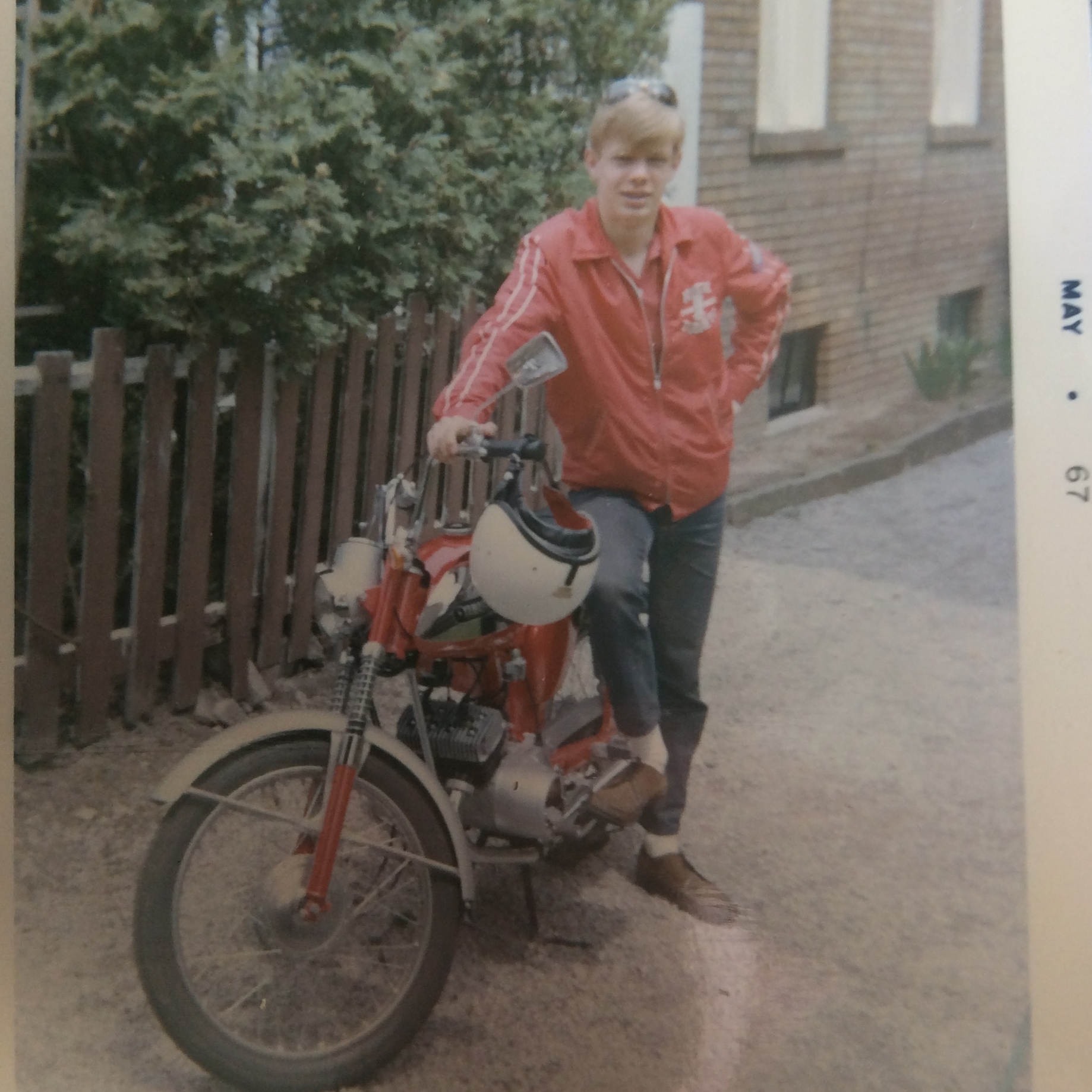
Yet there is a lot to lose and the cost / benefit equation seems to be shifting to less positive territory. Motorcycling is by nature a dangerous pastime. That’s part of what makes it exciting. While some of the danger can be mitigated by the right equipment and experience, I ride less often than in the past, so I feel that my skill set is subtly declining. Aging eyes and slowing reflexes don’t help.

I know from experience that it now takes far longer to recover from injuries. Minor injuries can become hugely inconvenient, but a more significant injury might be debilitating. As a friend said: “I’m not worried about dying on a bike. I’m worried about not dying; being seriously hurt and becoming a long term problem for my family.” I couldn’t stand being in a place where I was forcing others to provide me with care.
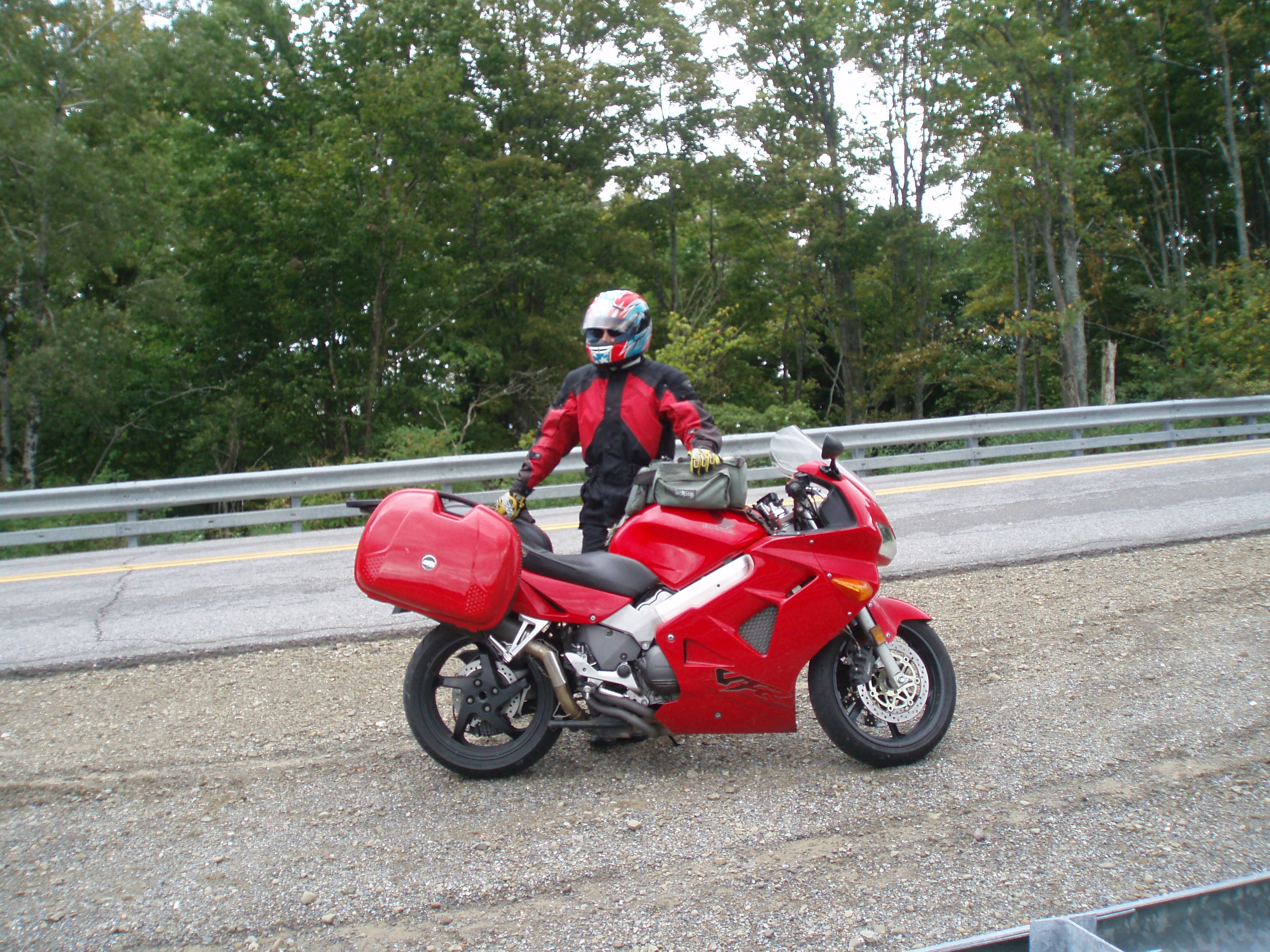
OLYMPUS DIGITAL CAMERAMy riding friends are intent on riding until they drop – presumably from non-motorcycle related causes. One suggests that riding a bike “too fast” is a way to stave off Alzheimer’s. Having a passion for something gives us a reason to live, and motorcycling is nothing if not a passion. Motorcycling is part of who I am; part of my character. While the motorcyclist in me might feel a smug satisfaction to dying at age 83 in a flaming bike wreck in the south of France, we can’t necessarily pick the time and circumstances of our passing to suit the narrative we construct for our lives.

And so I have a conundrum: does the potential cost – monetary or mortal – outweigh the psychological and adrenalin – producing benefits to riding ? I’m no longer sure. That said, there was something about the bike trip last year that has me thinking long and hard about doing it again next year. So in the best case scenario (best or worst depends on your perspective), I would have to say that the jury is still out. And the rope remains in the basement…..
 

World Class

June 10:  I believe that Toronto was once known for it’s spirit of innovation in “urban thinking”. Jane Jacobs lived here for a reason. The City was not afraid to experiment and try something new and different. There are many examples: the 45 foot by-law height limit and subsequent Central Area Plan brought in during the Crombie mayoralty come to mind. The St. Lawrence neighbourhood development. The “Kings” regeneration project has been hugely successful and brought thousands of new jobs and residents to King-Parliament and King – Spadina. But somehow that willingness to think outside the box has also yielded some very mixed results.

For example, our approach to bicycle lanes seems to me to be constantly changing. The City’s streetscape is often a hodgepodge of different attempts to find a home for street trees, newspaper boxes, benches and light poles. Depending on where you might be within the City, their location can change for no apparent reason other than the fact that the design thinking changed. To me that means that the City looks shabby and poorly organized, and the overall quality of the urban experience is diminished.

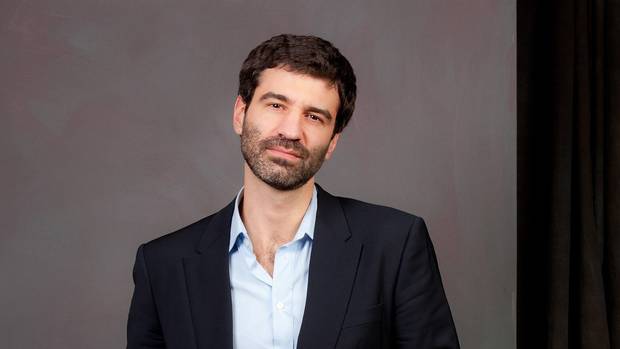
So it was with some interest that I read an interview with Jorn Weisbrodt, the Artistic Director of Luminato in today’s Globe and Mail. While he was speaking primarily about artists and the arts, I believe his thinking is more broadly applicable. He said, in part:

“When I came here, someone said to me that Toronto is already world-class, the world just doesn’t know it yet. And when I heard that, I thought it sounded really bizarre. I don’t think that is actually possible. If you are world-class, it means that the world talks about you. Certain criteria go with that. Toronto may be on the cusp of breaking through to be a world-class city, but that’s something the people of Toronto and the politicians need to want. They need to take steps to make it happen.

V. Tony Hauser
V. Tony Hauser

…Berlin became (a) haven for artists not just because it was Berlin but because the government was very smart after the wall came down. They let people take over empty spaces in East Berlin. They deregulated a lot. They let nightclubs take over these amazing spaces. I don’t think Toronto necessarily understands the mechanisms so well.

…The Hearn Generating Station is a huge gift to the City because of the possibilities that the space has and what it could be. It could be unique in the world. Toronto does too much 10 years too late, and things that other cities have been doing. These comparisons that people make, that Toronto is the Little Apple, or that the University of Toronto is Harvard of the North. Stop comparing yourself to others. That’s what people in puberty do. Grow up – be your own person and seize the opportunities where you can actually be (what you are comparing yourself to). Artists will always gravitate to somewhere where there is originality, where there is courage and where there is the possibility of greatness.”

http://www.theglobeandmail.com/arts/theatre-and-performance/jorn-weisbrodt-looks-back-on-his-legacy-at-the-luminato-festival/article30375308/

$25 Word

June 4:

Anthropomorphise: to attribute human characteristics to gods, animals and inanimate objects.

People have been doing it for years so I know that I am not alone. Pets are given names and welcomed into the family. Those names often reflect character traits we determine by assigning human values to their behaviours. Most of my cars and motorcycles have had distinct personalities. I’ve had my Honda VFR motorcycle for 15 years and I talk to it like a respected old friend. The Benzes were quiet and dignified, the Alfas energetic and outgoing.  When special effort was needed, I urged them on as if they could really hear, and when they broke down I cursed them. We all do it.

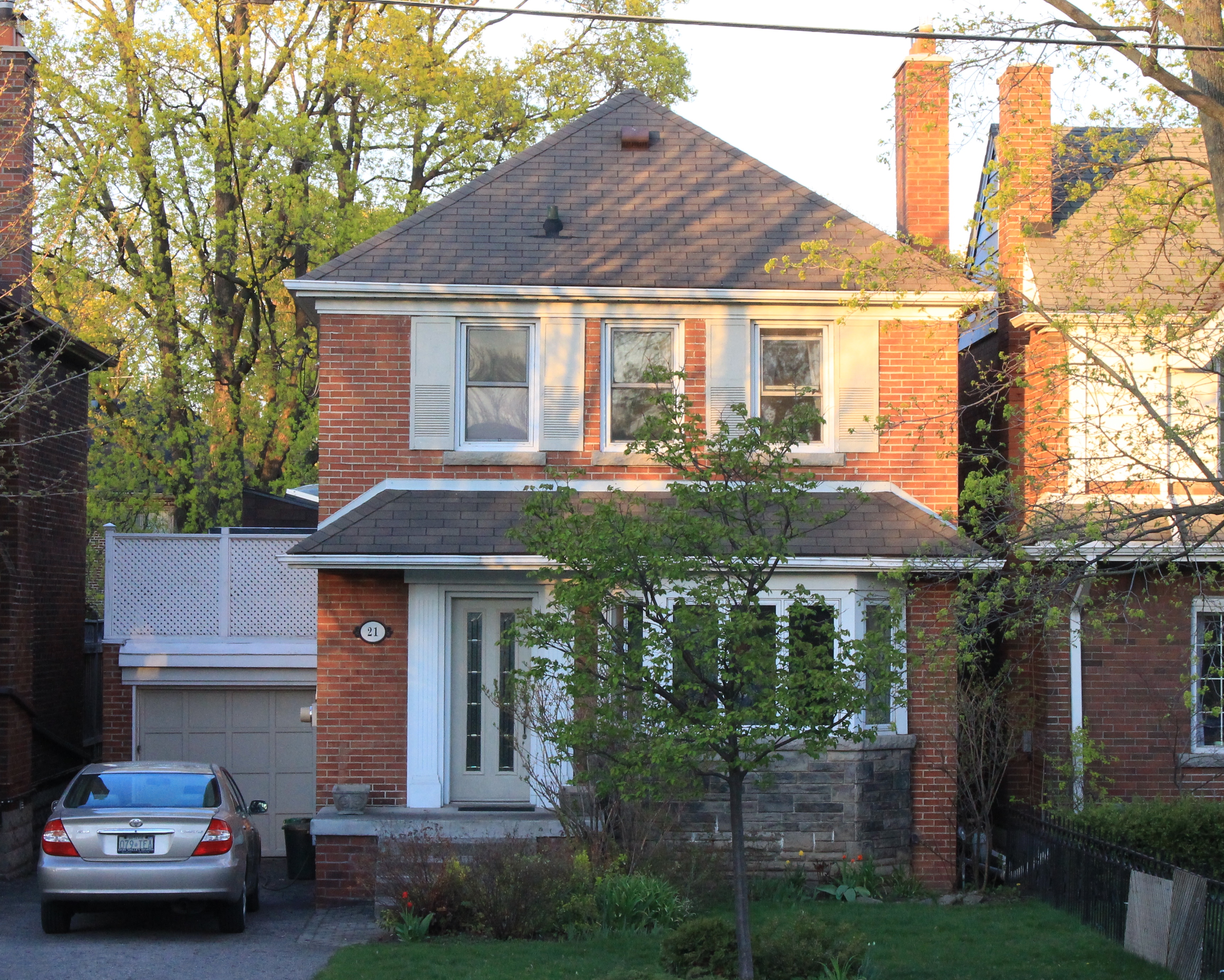
IMG_2143After recently writing about Leaside, I’ve been thinking more about the character of houses. Many of the houses are almost 100 years old, and like senior citizens, they portray a calm and respectable dignity. There’s a consistency to their size and appearance that makes them comfortable with each other. When I worked with architects, I often heard them allude to a “conversation” between buildings, and although they didn’t mean it literally, I think it nicely captures the  interplay between houses that we feel in our neighbourhoods.

Like groups of people, neighbourhoods have different personalities. Long Branch is an older area; many of the houses were cottages outside the city. There’s a real mix of scale and building materials that makes it funky and vibrant. The conversation there is like a cocktail party with a mix of guests. Cabbagetown, where I lived for 2 years,  is much older and has a completely different scale and texture. Brick Victorians and row housing makes it feel tighter and more enclosed. These guys have seen it all and they can tell you a really interesting story if you are prepared to listen.

Lately in Leaside there has been a rash of demolitions and rebuilding.  Having a power shovel appear on your front lawn must be the house-equivalent of terminal cancer in humans; you know that you are about to die, you just don’t know when. I often hear those houses saying: “No wait. There must be some mistake….”

I do not understand the attraction of a larger house – at least, larger than a standard Leaside 3 bedroom, 2 bath house. And I struggle with the concept of demolishing a perfectly serviceable home and essentially throwing it in the garbage, only to replace it with something new. New homes are often designed toIMG_2218 mimic older homes. This is in part due to zoning that regulates the height and setbacks, and it might also be a genuine desire on the part of the new kid to “fit in”. The trouble is that most of the newer homes try to affect permanence and solidity with faux stone and stucco; it doesn’t work. I might be more comfortable with the loss of a still-useful and comfortable home if the replacement was a well-thought-out and distinctly designed asset to the neighbourhood, but most of them use the same design and same layout and same building materials and so they come off as lame repetitive imitations.

At night, when it’s dark and quiet, I imagine the houses chatting about the day just passed. If a neighbourhood is a conversation among homes, what voice do the newcomers bring ? What do these homes say about the values and beliefs of their owners ? What will they be saying in 100 years ?