Cats and Dogs

September 20: The French have a well deserved reputation for loving their dogs. While pooches are pampered and taken everywhere, sadly, cats don’t seem to enjoy the same privilege.
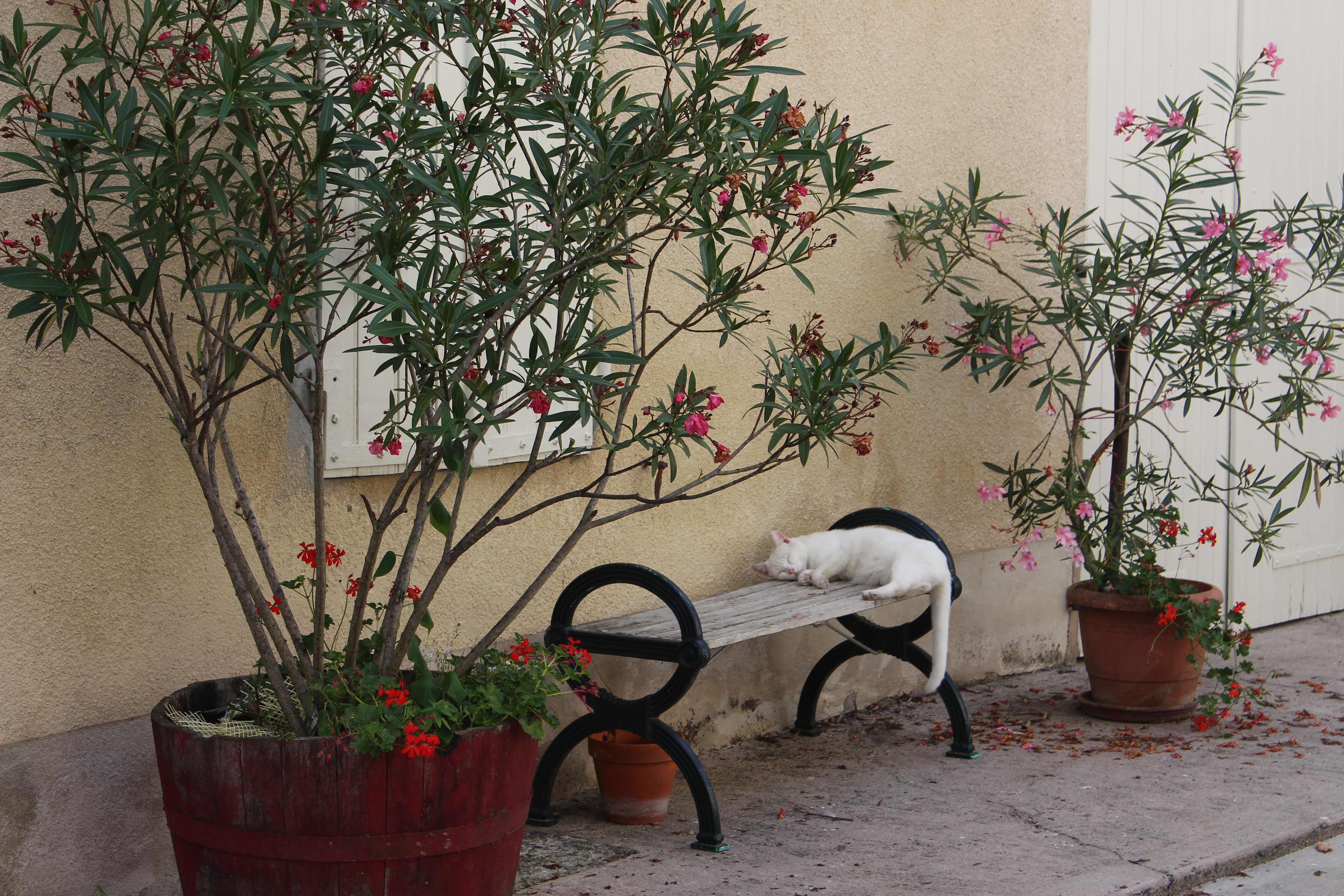
Many of the small towns I visited had groups of feral cats. I am sure that for every cat I saw on the street, there are many more safely at home behind closed doors, yet it was surprising to me that there were so many strays. Some, like this guy, seemed to have figured out how to live reasonably comfortably. They seemed to be fed (if not well-fed), but they would mostly scramble away if I tried to approach them.

I stayed in a small hotel in Entraygues.  There was a small grey and white male in the lobby when I entered. He was very scrawny and had obviously suffered some sort of injury to his hind quarters, yet he hung around the fringes of the action, never far from the owner. She told me that he had been “her first customer every day for three years”. He was at the door every morning expecting breakfast – which he got –  and then he wandered around for the day. She then said to me that, in all that time, she had never been able to pat him or touch him in any way. In spite of her care and attention, here was an animal so damaged that he could not bring himself to trust someone who obviously loved him.

Like humans, cats are social animals. They need to interact with other cats to have a full and rewarding life. It broke my heart to think of this poor guy being so alone and isolated because he could not overcome the fear created by circumstances that were, in all likelihood, not of his making. And it was not lost on me that I too lived alone. Like many others of my demographic, I ran the risk of diminishing  personal support and contact with others. It was something of which I was mindful, but had pretty much accepted as being part of my future.

And so it is somewhat ironic that I am now paterfamilias and chief caretaker of my Mum’s cat Duster. To be honest, before my Mum died, I had often thought that I would wind up with her; everyone else had kids, cats or allergies, so I was the logical recipient.

There has been a period of acclimation. Places have been found for feeding, sleeping and the litter box. The 3 AM yowling has (mostly) subsided, and we have settled into a routine of feedings and pettings and cleaning up that seems to work for us. I am perhaps less lonely, but that benefit has to be balanced against the commitment of having an animal in my care. An invite to my Sister’s cottage is now followed with a question of what to do with Duster. Still, she has wormed her way into my affections, and I may just have to accept that this small animal will make my life richer and more fulfilling. And hopefully, I hers.
September

September 6: The time around Labour Day always reminds me of a somewhat unhappy period in my life. In September 1964, I began attending North Toronto Collegiate (NT). I had been at Deer Park Public School where I was a pretty good student. I was happy and involved with friends, I got good (enough) grades, took part in extra-curricular activity, and found the whole experience enjoyable. As the time approached to make the transition to high school, I began to experience a certain amount of uncertainty about leaving this comfortable place behind.

One evening I rode my bicycle up to NT to have a look around. I peeked in the windows and saw the usual rows of desks, yet it did nothing to calm my anxiety. On the first day I was singled out and reprimanded because I had worn shorts, which was against school policy. The friendly faces of Deer Park disappeared in a torrent of much older and more mature students. Instead of the “Archie and Veronica at the Malt Shop” scenario I had imagined, I suddenly felt like a little kid again, and completely out of my depth.

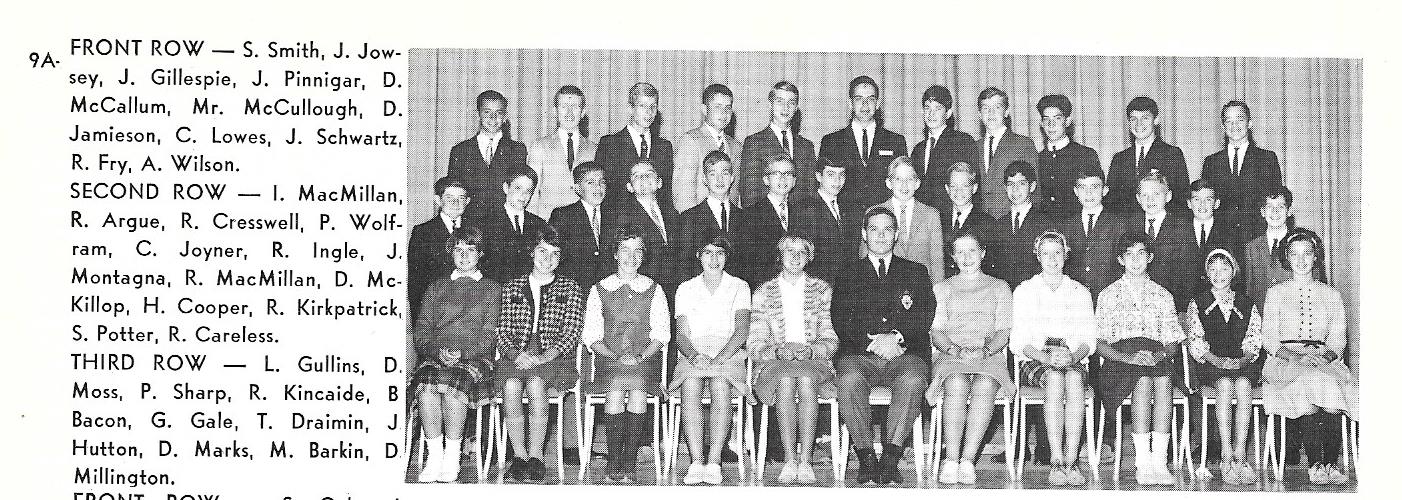
For reasons I have never understood, I started in class 9A, a music form full of very bright kids. Although it was never acknowledged explicitly, the classes seemed to be “sorted” by academic choice (music or art) and by ability. So 9A was pretty competitive. My progress in that environment can be divined by my telling you that I was asked not to play my instrument at the year-end concert. I was in 10F the following year. Then 11H and 12G. Throughout those years I felt quite intimidated and had little motivation to apply myself and try to improve my performance. I really couldn’t understand how declining Latin verbs, learning differential calculus or analyzing the Merchant of Venice was going to help me in later life. I doubt they have. There were long periods when I was deeply unhappy and had effectively given up.

Then came Grade 13. As I have written elsewhere, I was sent, against my wishes and in spite of my feelings for North Toronto, to the Canadian Junior College in Lausanne, Switzerland. The College modelled itself on the Neuchatel Junior College and allegedly had set high standards for its’ students. Since I got in with a solid 60% average, I suspect there was a certain amount of “putting bums in seats” during that first year. Call me “cash flow”.

We arrived at the school in early September, and I remember very clearly waking up the first morning in the house where I was billeted and looking out the window to see cows (with large bells around their necks) grazing around a wooden chalet. I was clearly not in Moore Park anymore.

In any event, in what was an even more intimidating environment than North Toronto, I blossomed. I signed up for the yearbook committee, I wrote a humour column for the weekly student newspaper*, I found new friends, I played and sang in a band and – lo and behold – my grades improved. Perhaps it was the implicit understanding that nobody knew much about my awkwardness at North Toronto that gave me “permission” to just be myself, have fun, work hard(er) and try new things. The experience truly changed my life.
I have really mixed feelings when I look back to those first early-September days at North Toronto. Those were not happy times for me, and I often wonder how different my life might be today if I had been able to more fully seize the opportunity the following four years presented, as I did in Switzerland. Looking back, they feel pretty much lost and wasted.

* * *

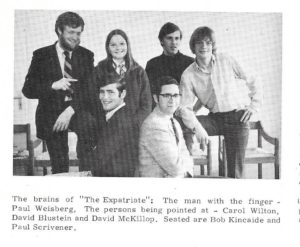
* If you look closely at this picture of the Expatriate gang, you will notice that one of the staff has a subversive finger raised which just happens to line up with the chair leg. The Yearbook editor didn’t realize it was part of the picture until I pointed it out to him – after the Yearbook (from which this picture is taken) – had been distributed to everyone at the school. Panic ensued….

Ronald Harry “Skip” Prokop

September 1: Although I never met him, Skip Prokop was a recurring presence in my life, surfacing at some significant moments, only to disappear and reappear after a while.

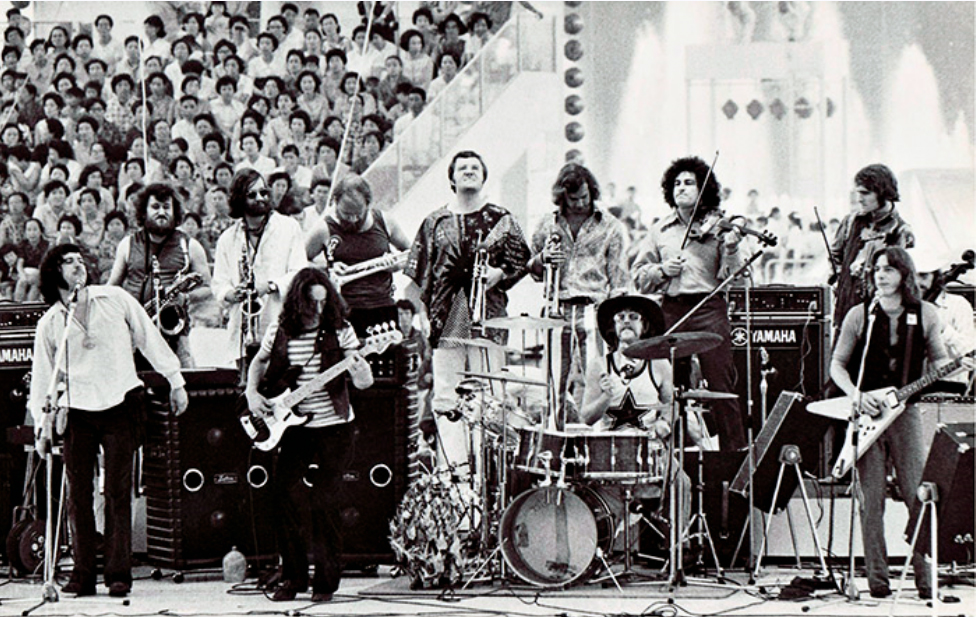
Prokop was a drummer and a founder of the Toronto rock band The Paupers. I first encountered them when I attended my “first concert” at the North Toronto Community Centre. It was probably 1966, and in the age of bell-bottom pants, I remember Prokop having to roll up his pant legs so that they wouldn’t get caught in the kick drum or high hat. It was a small room, and the volume must have been roughly equivalent to a 747 idling in a basement rec-room, but I remember the speed and flash of Prokop’s playing. In an age when the human metronomes of Ringo Starr and Charlie Watts were considered “great drummers”, Prokop was in a different league. Like others I have found subsequently (Neil Peart, Keith Moon, Steve Gadd, Buddy Rich to name a few), he brought texture and punctuation and rhythms not usually heard in a rock and roll format. To my then 16 year old self, he was the drummer I had always wanted to be, as I pounded away on the couch cushions with my Mother’s knitting needles.

When The Paupers folded, Prokop did studio work with Al Kooper, Carlos Santana, Janis Joplin and others, before returning to Toronto and forming Lighthouse, a 13-piece band which included keyboards, drums, guitars and a brass line, along with an amplified string section. Early members included Howard Shore and Russ Little who have both gone on to be stars in their own right. I first saw Lighthouse in the early 70’s at the Electric Circus on Queen Street East. It was a big venue and it was packed that night. I remember it as a rabbit warren of halls and rooms and windows and doors looking onto the stage where they performed under the de rigeuer “psychedelic” light show. It all felt very subversive. There may have been some form of recreational narcotics involved…

I saw Lighthouse many times including a gig at Convocation Hall in Toronto, a club on the docks in Port Carling (the Surf Club ?) and a dance at Vic Park Secondary School. I loved their music since it was essentially an evolution of the big band music that my parents played at home. There was something very appealing about the big band format, playing loud enough to part your hair, while allowing for improvisation and solos from everyone. I loved watching Prokop’s energetic contributions. It’s a jazz format I still enjoy today.

Lighthouse re-emerged from time to time in different formats in subsequent years, and Prokop went on to do some work in radio. He died on August 30 of a heart condition. I will not remember that date the way I remember hearing that John Lennon had been shot. Still, it feels like the loss of a presence that played a role at significant moments in my life. I’ll miss that.

https://beta.theglobeandmail.com/arts/music/lighthouse-co-founder-skip-prokop-made-rock-history/article36218827